
Whole-Food Nutrition vs Synthetic Supplements: Why the Form Matters
Are whole-food supplements better than synthetic vitamins?
Whole-food nutrition delivers nutrients embedded in their natural food matrix — fiber, enzymes, polyphenols and mineral cofactors that influence how the nutrient is absorbed and used — while synthetic supplements deliver an isolated molecule at a high dose. For correcting a diagnosed deficiency, isolated supplements are precise and effective. For general daily nutrition, whole-food concentrates tend to be better tolerated and carry a wider spread of compounds, which is one reason food-based intakes of nutrients like beta-carotene and vitamin E track with better health outcomes in observational research while high-dose isolated versions of the same nutrients often do not.
- Isolated supplements are the right tool for a diagnosed deficiency
- Whole-food concentrates carry cofactors and fiber alongside nutrients
- The food matrix affects absorption and tolerance
- High-dose isolated antioxidants have repeatedly failed to replicate food-based benefits
- Concentration is not the same as extraction
Are whole-food supplements better than synthetic vitamins?
For most nutrients, whole-food-derived formulas deliver cofactors and phytonutrients that isolated synthetics lack, which improves how the body uses them. Some isolated forms, like B12, are still the practical choice.
Do I need a multivitamin if I eat well?
Often not. A concentrated whole-food formula is a better hedge than a high-dose synthetic multivitamin when your diet is already varied.
Concentrated whole-food formulas — food first, isolated compounds second.
Browse the full catalog

The question is not whether supplements work. It is what a nutrient does when you separate it from everything it grew up with.
The food matrix is not packaging
An orange is not vitamin C plus filler. It is vitamin C alongside flavonoids, fiber, and organic acids that change absorption rate and antioxidant behavior. Strip those away and you have a different intervention with the same label.
This is why nutrition science keeps producing the same pattern: eating more of a nutrient in food correlates with better outcomes, then a trial gives a high dose of the isolated version and finds nothing — or occasionally harm.
Concentration versus extraction
There is a middle path that gets lost in the argument. Concentrating a food — removing water and fiber bulk while keeping the full spectrum of compounds — is not the same as extracting a single molecule.
Traditional herbal food preparation has worked this way for centuries: reduce, combine, balance. Modern whole-food concentrates are an industrial version of the same idea.
- Extraction: one molecule, high dose, precise, context-free
- Concentration: whole spectrum, moderate dose, food-like
- Fortification: synthetic nutrients added back to a processed base
Where isolated supplements are clearly right
Diagnosed B12 deficiency, low vitamin D in northern winters, iron deficiency anemia, folate in pregnancy — these call for a known dose of a specific nutrient, and food-based approaches are slower and less certain.
Being pro-whole-food does not require being anti-supplement. It requires matching the tool to the job.
What to look for on a label
Named whole foods and herbs rather than a proprietary blend of chemical names. A short list. And a manufacturer who controls their own sourcing, because with plants, the farm is the formula.
Concentrated whole-food formulas — food first, isolated compounds second.
Browse the full catalogFrequently asked
- Are whole-food supplements better than synthetic vitamins?
- For general daily nutrition, whole-food forms are typically better tolerated and carry cofactors that isolated vitamins lack. For correcting a diagnosed deficiency, a measured synthetic dose is usually the better tool.
- Are synthetic vitamins bad for you?
- Not inherently. Some high-dose isolated antioxidants have shown no benefit or slight harm in trials, but standard multivitamin doses are generally safe. The issue is expecting an isolate to reproduce the effect of a food.
- What does bioavailability actually mean?
- How much of a nutrient your body absorbs and can use. It is influenced by the chemical form, the other compounds present, and your own digestion — which is why the same milligram number on two labels can behave differently.
Put it into practice
Browse whole-food herbal nutrition, clean beauty, and non-toxic home essentials from Sunrider's own farms and labs.
Keep reading
Ready to order?
Everything here ships direct from Sunrider at official pricing, with the manufacturer guarantee — no marketplace reseller in between.
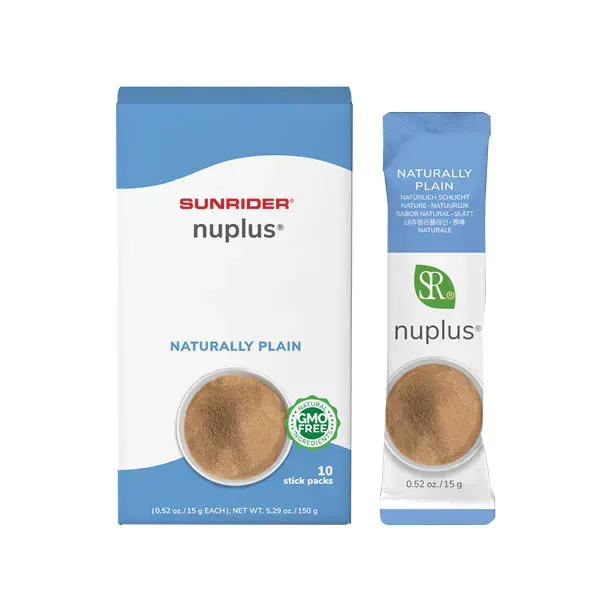
NuPlus® — $32.64 · SKU 0186734 · temporarily out of stock